
A planning model, not an earnings promise
Monthly income & profitability calculator
One transaction means one paid job or one account’s monthly bill. Use the same unit throughout. Recurring share divides existing volume; it never adds sales. Include owner compensation in costs if you want profit after paying for that work.
Estimated operating profit before taxes
$2,700.00- Revenue
- $5,000.00
- Contribution per transaction
- $175.00
- Break-even transactions
- 5
- Transactions for desired profit
- 34
- Returning / new transactions
- 12 / 8
- Delivery hours at entered volume
- 60
Revenue = price × transactions. Profit = revenue − variable costs − fixed costs − marketing. Required count = round up((desired profit + fixed + marketing) ÷ (price − variable cost)). Break-even uses desired profit of zero. Taxes, debt principal, equipment purchases and payment timing require a separate cash-flow plan.
Three illustrative paths to $5,000 revenue
| Example service model | Monthly transactions | Average value | Revenue | Capacity question |
|---|---|---|---|---|
| Recurring cleaning visits | 20 | $250 | $5,000 | Can you deliver 20 fully scoped visits? |
| Property maintenance accounts | 10 | $500 | $5,000 | What work is actually included per account? |
| One-time service projects | 5 | $1,000 | $5,000 | Can you consistently win and complete five projects? |
Follow a dollar past the sale
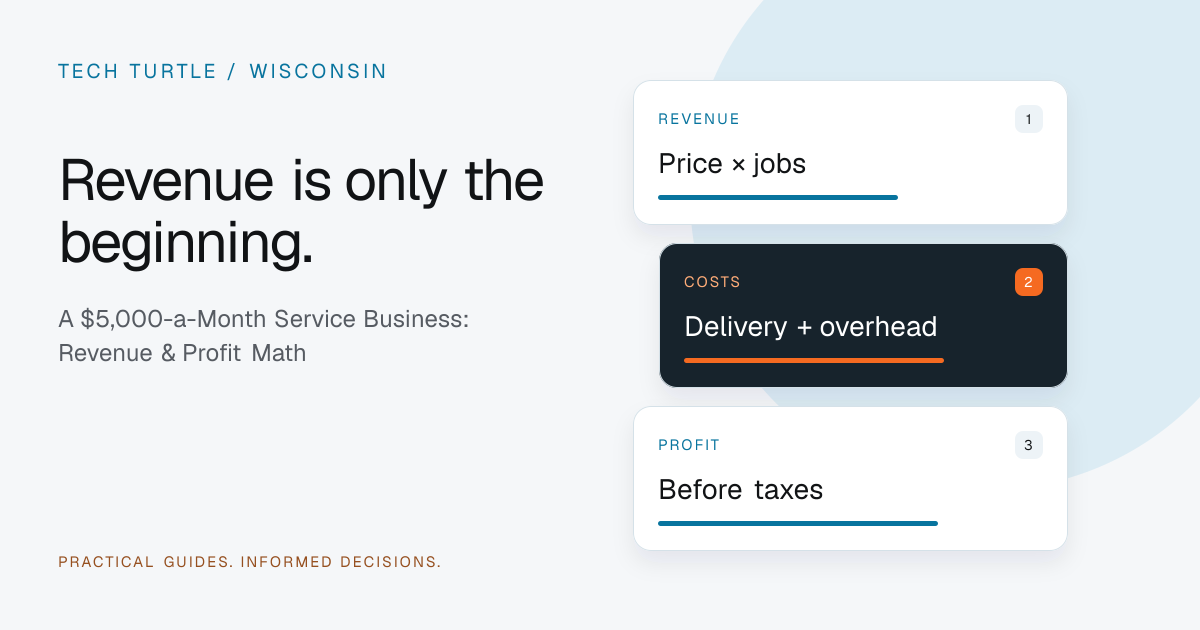
At 20 transactions × $250, revenue is $5,000. If each transaction costs $75 to deliver, variable costs are $1,500. Subtract $600 fixed operating costs and $200 marketing: modeled operating profit is $2,700 before applicable taxes and other excluded costs. The example is invented arithmetic for planning, not a Tech Turtle client outcome.
Include a realistic cost for owner labor if you want profit after compensating the work. Loan principal, capital purchases, sales-tax collections and customer payment timing need a separate cash-flow plan. Do not treat this calculator as a tax return or household-income forecast.
Work backward from the income you want
Contribution per transaction is average price minus variable cost. With $175 contribution and $800 fixed/marketing costs, a $5,000 operating-profit target requires ceiling(($5,000 + $800) ÷ $175) = 34 transactions, or $8,500 revenue at $250 each. Break-even is five whole transactions under these assumptions.
If the contribution is zero or negative, no higher volume fixes the model as entered. Raise price, reduce legitimate delivery cost or change the offer. The calculator shows no finite target count in that case.
Check the calendar before chasing volume
At three delivery hours each, 34 transactions require 102 hours before sales, travel and administration not included in that allowance. Enter a realistic monthly capacity; if demand requires more hours, change scope, scheduling or staffing rather than promising impossible dates. Hiring adds supervision, payroll and classification obligations.
Recurring share only splits the same transaction count into returning and new work. It does not multiply revenue or guarantee retention. Track cancellations and actual repeat purchases before budgeting next month’s work.
Move from first customer to repeatable work
- Validate one defined service with a paid customer and written scope.
- Measure actual delivery time and costs; revise the offer.
- Ask for honest feedback and permission to show useful work examples.
- Offer appropriate repeat service without assuming acceptance.
- Track inquiries, quotes, completed work and cash received separately.
- Increase volume only after the schedule and contribution remain workable.
Plan for a weaker month
Run the calculator at lower customer counts, higher variable costs and a smaller recurring share. Keep cash for slow seasons, repairs, refunds and late payment. Wisconsin businesses with outdoor services should test winter and growing-season scenarios separately. A good forecast identifies when to slow spending, not just how much you hope to sell.
Common questions
Does this promise $5,000 a month? No. Every result depends on your inputs and actual demand; no income outcome is guaranteed.
Does recurring percentage add sales? No. It classifies the entered transactions into returning and new work. Revenue is unchanged.
Is operating profit spendable cash? Not necessarily. Taxes, debt payments, equipment purchases and collection timing can change available cash.
Make your next step easy to find
Make it easier for customers to understand your service and contact you. A website can support inquiries and follow-up, but it cannot establish demand or guarantee your revenue target.
A $5,000-a-Month Service Business — action checklist
A preparation aid, not a certification, legal contract or guarantee of work. Checkmarks last for this visit; download your progress before leaving.
0 of 7 ready
Put this guide to work
Optional help from a real Wisconsin team
Have a website or resource question?
Ask Tech Turtle a question or report a resource correction. We can explain our website service or point you to a published resource. Funding providers decide eligibility; we do not submit grant applications or provide individualized legal or financial advice.
Sources & review notes
Official references checked October 30, 2026. Program availability, fees and rules can change. Original budgets are planning examples, not quotes or earnings forecasts. This is general education, not individualized legal, tax, financial or safety advice.
- SBA business planning and startup costs
- Wisconsin SBDC no-cost consulting
- Wisconsin DOR: starting a business
Published by Tech Turtle, a Wisconsin website business. We are independent of the agencies and funding providers listed. Report a correction or ask about website help.