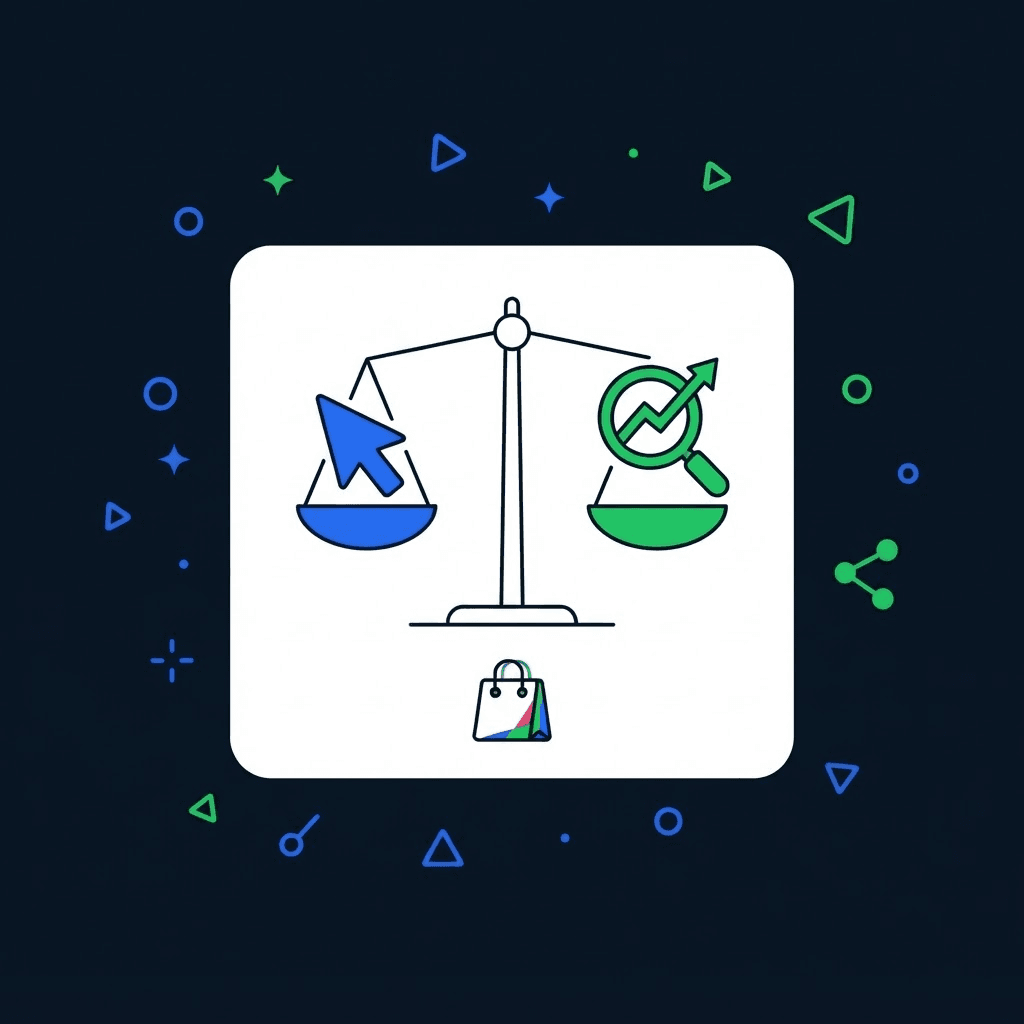

Every Wisconsin retailer and online seller eventually faces the same fork: pour the marketing budget into Google Ads for immediate sales, or invest in SEO to build traffic that compounds? The honest answer is that they solve different problems, and the right move depends on where your business is right now. This framework will help you decide — and show why the best retailers rarely pick just one.
Ads are rented, SEO is owned
Google Ads buys you traffic instantly but stops the moment you stop paying. SEO takes months to build but becomes an asset you own. Speed versus ownership is the core trade-off — and the smartest retailers balance both.
What Google Ads is great at
Google Ads puts your products in front of ready buyers immediately. For a retailer, that speed is invaluable in specific situations.
- Launching a new store or product line and needing sales now
- Promoting a seasonal sale or limited-time offer
- Testing which products and messages actually convert
- Filling gaps while slower SEO efforts mature
The catch is that you pay for every click, and the traffic vanishes when the budget does. Ads reward tight targeting, strong product pages, and disciplined tracking. Spend without those and you'll fund clicks that never become customers. We go deeper on the trade-offs in Google Ads vs. SEO.
What SEO is great at
SEO is the long game that pays off. By earning organic rankings for the terms your customers search, you build a stream of traffic you don't pay for per click. For a retailer squeezed on margin, that lower blended cost of acquisition is a serious advantage over time.
The trade-off is patience — SEO takes months to build momentum. But unlike ads, the asset keeps working after you stop actively investing, and it compounds as your catalog and content grow.
Neither works without a store that converts
Ads and SEO both just deliver visitors. If your product pages are slow, confusing, or hard to check out on, both channels leak money. A conversion-focused website is the foundation that makes every marketing dollar — paid or organic — work harder.
A simple framework for deciding
Instead of "ads or SEO," ask where your business is right now.
- 1Is your website ready to convert? If not, fix that first — nothing else matters.
- 2Do you need sales this month? Lean into ads for speed.
- 3Do you have margin and patience to build a durable asset? Invest in SEO in parallel.
- 4Are you promoting something time-bound? Ads win for the window.
- 5Do you want to lower long-term acquisition cost? SEO compounds.
For most Wisconsin retailers, the answer is a blend: ads to turn on demand today, SEO to reduce your dependence on paid traffic tomorrow. The proportion shifts as your organic presence grows.
Instant
ads deliver traffic the day they launch
Compounding
SEO builds owned traffic that lasts
Convert first
both channels need a store that closes the sale
How to combine them without waste
The two channels make each other better when run together. Ads generate immediate data on which products and search terms convert — insight you can feed straight into your SEO priorities. Meanwhile, growing organic rankings let you gradually reduce paid spend on terms you now rank for, freeing budget for testing new ones.
Ads and SEO aren't rivals — they're a relay. Ads sprint out of the gate for sales today; SEO builds the endurance that lowers your costs for years. Retailers who run only one leave money on the table.
A retail example
The luxury retail work in the case study below reflects the foundation this all rests on: a store that presents products beautifully and converts. With that in place, both ads and SEO have something worth sending traffic to — which is exactly the point.
For Wisconsin retail and e-commerce, the ads-versus-SEO question is really a sequencing question. Make your store convert, use ads for speed and testing, and build SEO for durable, lower-cost traffic. Balanced well, they compound into a marketing engine no single channel could match.
Not sure how to split your budget between the two? A free marketing audit will assess your store and channels, or book a quick call and we'll build the plan with you.
Relevant case study
Real work for a business like yours

AIM Luxury Timepieces
A generic store template rebuilt into a dark, cinematic luxury-watch brand with buy, sell, trade, and source flows for an independent Wausau dealer.
A true luxury brand experience
View the full case studyFrequently asked questions
If you need sales now and have a converting website, ads deliver traffic immediately. SEO is a slower, compounding investment that builds an asset you own. Most successful retailers use ads for speed and specific promotions while investing in SEO for durable, lower-cost traffic over time.
Usually yes, but only after your site can convert. SEO brings free, high-intent traffic over time, which is powerful for a store with margin pressure. The catch is patience — it takes months to build — so it works best alongside a faster channel like ads rather than as your only play.
You can, but you'll be renting all your traffic. The day you stop paying, it stops. Skipping SEO entirely means never building the owned, compounding traffic that lowers your blended cost of acquisition over time. The strongest retailers do both, in the right proportion.
Want a website that actually generates customers?
Get a personalized website and marketing plan based on your business, your goals, and the customers you want to reach in Wisconsin.

Written by
Logen Doiel
Founder, Tech Turtle Marketing
Logen Doiel is the founder of Tech Turtle, a Wisconsin marketing partner that helps local and service-based businesses turn online attention into real customers. He works directly with every client — from the first audit to launch and beyond — building websites, local SEO, and advertising that work together to generate calls and leads, not just look good.